Learning a second language from an early age can become a natural part of a child’s educational experience.
For families considering a bilingual kindergarten, however, it is important to understand what bilingual education actually means and what parents should look for when choosing a school.
A bilingual kindergarten should be more than a school that adds a short foreign-language lesson to the timetable.
Ideally, children should have meaningful opportunities to hear, understand and use another language in an environment that feels natural, positive and age appropriate.
What is a bilingual kindergarten?
A bilingual kindergarten is an early education environment where children are exposed to two languages as part of their educational experience.
The exact balance between the languages can vary considerably between schools.
Parents should therefore ask:
- How frequently is the second language used?
- Who speaks it with the children?
- Is it used during activities?
- Is there English-language interaction beyond formal lessons?
- How are children supported if they have different levels of exposure?
These questions are often more useful than simply looking for the word “bilingual” on a school’s website.
Why start language learning early?
Young children spend much of their day learning through listening and interaction.
They hear adults, imitate sounds, learn vocabulary, communicate their needs and gradually understand increasingly complex language.
A second language can become part of this process when children encounter it consistently in meaningful situations.
The goal should not be to create pressure.
Children should feel comfortable experimenting, listening, repeating and communicating.
Bilingual education should be enjoyable
Young children learn differently from older students.
They are naturally motivated by:
- stories,
- songs,
- games,
- movement,
- art,
- role play,
- repetition,
- social interaction,
- and discovery.
A bilingual kindergarten can use these activities to create opportunities for children to hear and use English.
This is particularly important for younger children because language learning can become associated with positive experiences rather than formal academic pressure.
English through everyday experiences
One of the strongest aspects of an immersive environment is that language becomes connected to real activities.
For example, children can encounter English while:
- playing,
- singing,
- creating art,
- participating in physical activities,
- following classroom routines,
- listening to stories,
- communicating with teachers,
- and interacting with other children.
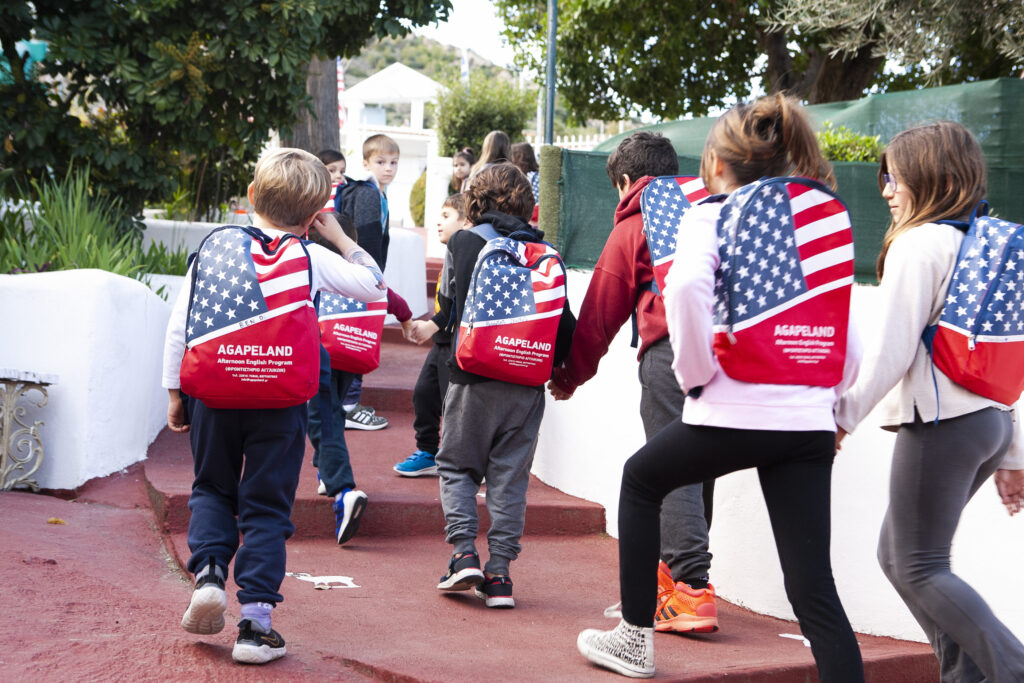
Agapeland describes its youngest programme, Cocoons, as a full English immersion environment, with children from 2.5 years old participating in learning and play activities.
The wider school describes itself as an English-Greek preschool and kindergarten.
Bilingualism and confidence
Children need to feel safe making mistakes.
If a child worries that every word must be perfect, they may become reluctant to speak.
A supportive language environment encourages children to try.
This is why parents should look at the emotional environment of a bilingual school as well as its language curriculum.
Agapeland’s stated philosophy emphasises joyful learning and confidence rather than pressure, while its English programme uses small groups to encourage conversation, teamwork and confidence.
Language and social development
Language is not only an academic skill.
Children use language to:
- make friends,
- ask for help,
- express emotions,
- negotiate,
- solve disagreements,
- tell stories,
- participate in games,
- and communicate ideas.
Consequently, a strong bilingual programme can integrate language development with social and emotional learning.
Agapeland’s programmes explicitly include friendship, communication, active listening, sharing, conflict resolution, patience and teamwork.
Bilingual education and creativity
Creative activities provide excellent opportunities for language.
A child might learn vocabulary while:
- painting,
- making a collage,
- singing,
- dancing,
- working with musical instruments,
- or participating in a group project.
Agapeland’s kindergarten programmes include arts and crafts, music, cooking and physical activities alongside academic learning.
This creates a broader educational experience in which language is connected to action and experience.
What should parents look for in a bilingual kindergarten?
When visiting a bilingual kindergarten, parents should ask several questions.
How much English do children hear?
There is a significant difference between one short English lesson and an environment where children regularly hear English.
Is the language age appropriate?
The language should be presented in ways young children can understand.
Is communication encouraged?
Children need opportunities to participate rather than simply listen.
Are activities enjoyable?
Young children should experience language through play, stories, music and activities.
How are different language levels handled?
Not every child enters kindergarten with the same exposure to English.
Does the school support the whole child?
Language should be one component of a broader programme including social, physical, emotional and cognitive development.
Bilingual Kindergarten in Lagonisi
For families searching for a bilingual kindergarten in Lagonisi, Agapeland offers an English-Greek educational environment in the Lagonisi area.
The school provides programmes beginning from approximately 2.5 years old and continuing through the preschool and kindergarten years.
Its educational environment combines English-language exposure with creative activities, physical development, social skills, exploration and preparation for primary school.
The school also offers an after-school English programme from age 4 through adulthood, although this is separate from the preschool-kindergarten programme.
Why Consider Agapeland for Bilingual Education?
Agapeland is particularly relevant for families who want early exposure to English to be part of their child’s wider school experience.
Its youngest children enter an English-immersion programme, while the school overall operates as an English-Greek preschool and kindergarten.
The educational approach combines language with play, creativity, physical activity, social development and exploration.
For parents in Lagonisi, Kalyvia, Koropi and the surrounding South Attica area, the best next step is to visit the school and see how the bilingual environment works in practice.
Contact Agapeland to arrange a visit and discuss your child’s age, previous language exposure and the current programme.